It all started with frustration
Back during the pandemic, my brother and I were playing mostly online games with friends we had known since high school. There was a sense of lost nostalgia for the experience of playing in person. The flow of conversation, crowding around an important roll to see the result, and the feel of a real book in your hand were missing sometime from pure online play. So, my brother decided to go all in. He started three separate campaigns at multiple local game stores after he retired early from a career. At this point, our discussions became focused on making life easier for the in-person GM.
The Laptop GM
Arcwynd is a laptop GM. I completely understand the benefit and allure of pure analog gaming. Put your phones away. Stow the tablet. Focus in on just gaming. Cool. However, for Arcwynd and I, we love to prep. Both of us use a world-building tool to keep it all organized. I discovered scabard.com years ago, and that is where I keep my notes for my homebrew world of Evermorn. As 100% of my games were online, I kept a litany of browser tabs open during the game - D&D Beyond, Scabard, Roll20 then Foundry, google searches, etc. It was manageable. In any case, we both are laptop GMs. I have terrible handwriting, and I am much faster typist than I am writing by hand. So, I am stuck in the world of digital prep until we enter a future dystopia when AI overlord forbids human access to the digital world. So, what is a laptop GM?
While playing in person, the Laptop becomes the second GM screen. Some GMs like us end up using a laptop or tablet to keep their games organized while playing. Especially when one is world building or using an already published setting, a laptop can become a faithful companion. Plus, Arcwynd has players who love to keep notes AND help write his after session report (the Session Log in Quoth), and to update entries in their game history. Once you start displaying maps on a flatscreen TV, which many in person GMs are doing now, a laptop becomes essential. 
The rant about the current slate of world building apps
Here is where the frustration really began.
Most world-building apps seem to assume that every GM is secretly Brandon Sanderson with a publishing contract, a team of continuity editors, and twelve thousand years of fictional history waiting to be documented. Apparently, before I can run four friends through a haunted mill, I need to establish the complete theology of the region, define seven historical epochs, create a genealogy for the local baron, and explain how plate tectonics shaped the trade routes of the northern provinces.
I do not need to build the second coming of the Cosmere. I need to remember that the suspicious miller is named Tobin, not Tobias, and that he has the key to the cellar.
That is the actual problem most GMs are trying to solve.
We want to plan a great game. We want compelling scenes, useful NPCs, memorable locations, and enough structure to keep the evening moving when the players inevitably ignore the obvious plot hook and become emotionally invested in a goblin we invented twelve seconds ago. We are not trying to construct a fictional encyclopedia so comprehensive that future scholars can debate the agricultural economy of the Third Elven Dynasty.
Then there are the world-building apps designed around the touching belief that players will spend their free time studying your lore.
You carefully write six pages about the ancient conflict between the houses of Valdrin and Morcant. You upload maps. You create family trees. You document the religious schism that led to the War of the Ashen Crown. Then you send the players a link.
Nobody clicks it.
At the next session, one player asks which kingdom they are in. Another cannot remember the name of the villain. A third says, “Wait, are we working for the queen or trying to kill her?” The fourth has read everything, but only because she is your daughter and feels sorry for you.
Players are busy. They have jobs, children, appointments, and an endless supply of television programs specifically engineered to consume every remaining minute of human consciousness. Most of them are not going to spend Wednesday evening reviewing your fictional history before Saturday’s game. They should not have to. The game should help them remember what matters while they are playing.
And then there are the apps that are not really world-building tools at all. They are business productivity platforms wearing a wizard hat.
Sure, you can use them to run a campaign. First, create a workspace. Then build a database. Then connect the database to another database. Then install three plugins, configure seven templates, watch a forty-minute tutorial, learn the platform’s private language, and paste in some code written by a stranger on Reddit who assures you it “works perfectly now.”
Wonderful. I only wanted to plan an owlbear encounter.
I have no desire to become the unpaid systems administrator for my own hobby. I do not want to spend two hours customizing a project-management platform so that the column labeled “Quarterly Deliverable” says “Adventure.” I do not want to configure automations, design relational databases, or troubleshoot why the NPC template stopped displaying character portraits after the latest plugin update.
This is a game. I already have a job.
The in-person GM needs something different. We need a tool built around the actual rhythm of a game night. We prepare material. We bring some of it to the table. We search for information while six people stare at us. We reveal pieces of the world when they become relevant. We send players the things their characters know. We keep secrets from the characters who do not know them. We record what happened after the players completely dismantle the evening we planned.
The tool should support the game, not become another campaign we have to manage.
That's the day we started imagining what would become Quoth GM.
The Tools I Already Love
To be clear, I am not against world building. I love world building.
I am exactly the kind of GM who writes the long history of a forgotten empire that collapsed eight hundred years before the campaign began. I have thousands of pages of stories, NPCs, locations, factions, legends, religions, and events. Most of it will never appear directly in a game, and I regret nothing.
Obsidian is an extraordinary writing and knowledge-management tool. It is flexible, fast, and powerful. With enough care, you can build a deeply connected campaign archive that works exactly the way your brain works. I created my own templates, folder structures, links, and systems for keeping track of my world, and Obsidian has been wonderfully helpful.
Scabard.com has also been an important part of my homebrew work for years. It was built specifically for RPG world building, and it understands the relationships between characters, places, events, organizations, and campaigns in a way that general-purpose tools often do not. It gave me a place to organize Evermorn and connect the many moving parts of a large setting without reducing everything to a pile of disconnected documents.
Both tools helped me build and preserve my world.
The problem appeared when I sat down to run the game.
Even after creating my own templates and carefully organizing everything, I still found myself clicking through several pages to locate a scene, opening multiple tabs, navigating back through folders, or using a search bar while the players waited. The information was there. It was organized. It was connected. It was just not always where I needed it at the exact moment I needed it.
That distinction matters.
A world-building tool helps you create and organize the world. A session tool helps you run tonight’s game.
Quoth Starts With the Session
Quoth begins with the assumption that the GM is preparing for an actual night of play.
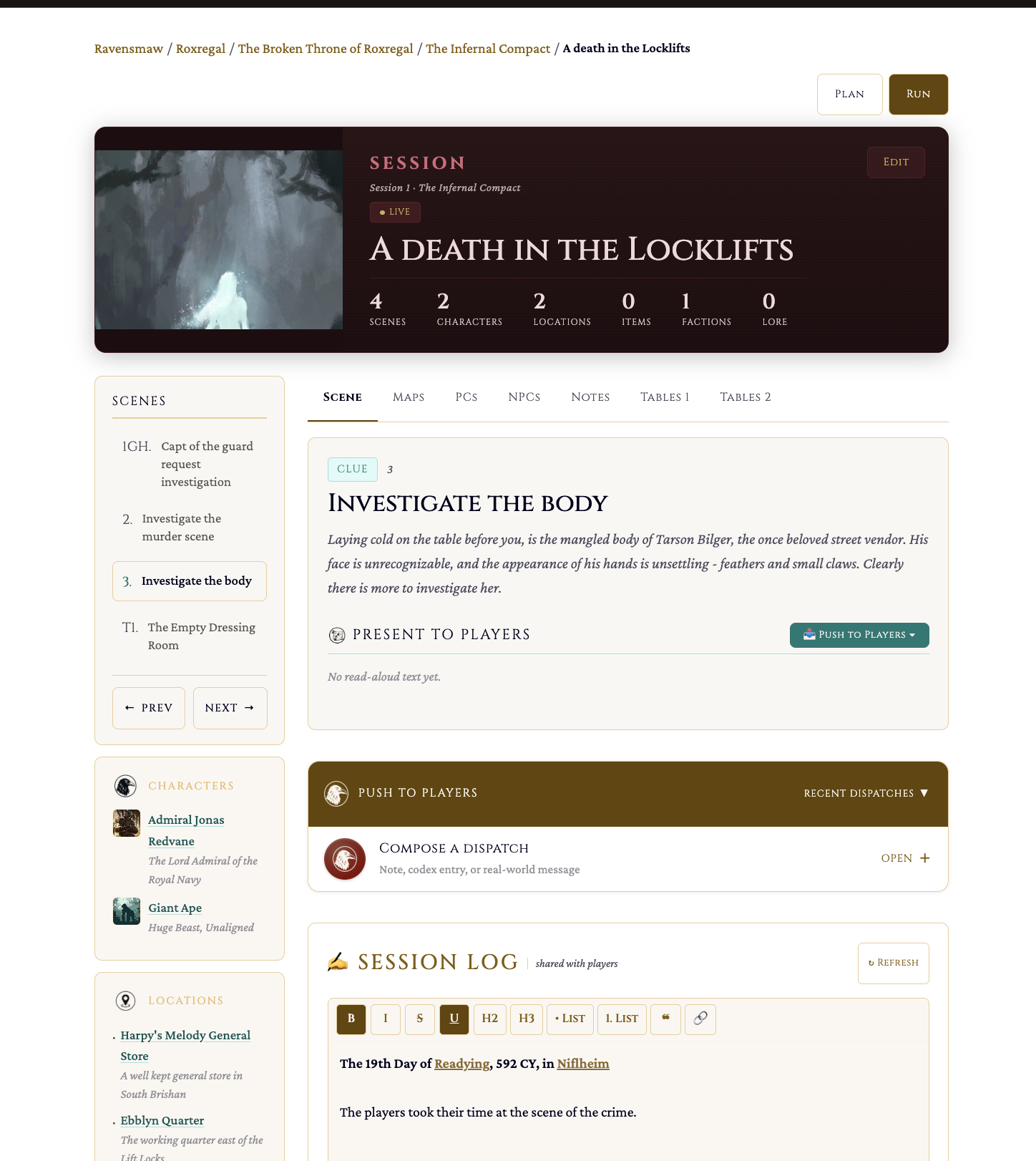
The session is organized scene by scene. Each scene is immediately available from the session screen. Stat cards stay on the same tab. Custom random tables stay on the same tab. Initiative trackers stay on the same tab. Maps stay on the same tab. The goal is to keep the material needed during play one click away, without hunting through folders or hoping the search bar understands what you meant.
The world still matters. The campaign still matters. Adventures, characters, locations, factions, and histories still matter. Quoth simply brings the pieces needed for the current session to the surface.
It also connects the GM’s preparation directly to the players.
I can send a map, NPC, location, item, or piece of lore directly to a player’s phone. I can send private notes and secret information without asking someone to leave the table or hoping they notice a text message buried under six unrelated notifications. The material is saved in the player view, so it remains available every time they log in.
Players can also help write the session log while the game is happening. There is no separate Google document to open, share, locate, and then forget about. The record of the session lives with the session itself.
Quoth does not claim to do something no other application can possibly do. With enough plugins, customization, integrations, templates, tabs, and determination, you can reproduce many of these functions elsewhere.
That is not the point.
Quoth tries to put them in one place, make them easy to use, and have them ready when the game begins.