Building Better Sessions: Using the 8-Step Approach
In his influential book The Return of the Lazy Dungeon Master, Michael "Sly Flourish" Shea outlined a streamlined 8-step process for session planning that has become the gold standard for Game Masters everywhere—millions of us have adopted it for our weekly prep, whether we admit it or not.
When we were building QuothGM, that ease of approach was the thing I kept chasing. It's why I built the whole system to be as streamlined or as detailed as you feel like being on any given Tuesday night at 9pm with a session tomorrow.
If you are building your world one game at a time beyond a general sketch of the setting, QuothGM is pretty much built for that style of planning. You can certainly do worldbuilding QuothGM, but the speed is engineered for those few hours you get to spend each week planning the game.
So, with that in mind, the first place I would start is the characters. If you root your work there, you won't waste 45 minutes drafting the org chart for the thieves guild in a town you players won't visit in game for a year in real time.
The Core Philosophy: Spiral Outward from Characters
Most world-building apps treat a scene, or an entire adventure, like just another wiki entry to be filed and admired. QuothGM doesn't do that. Every week you're faced with the same simple choice: plan just your next session, or plan out every scene in the adventure. Neither is wrong—it's whichever one you're in the mood for this week. The fundamental insight, straight from the Lazy Dungeon Master playbook: build your world from the inside out, starting with your players' goals and expanding outward only as needed.
This is where QuothGM is tuned.
Step 1: Review Your Characters' Goals
Before planning anything, understand what your players want to do. This is something every GM should be doing anyway—QuothGM just gives it a home instead of a sticky note.
When you review the characters as the first stage in your game preparation, you're priming yourself to build the rest of the elements of your prep around those characters. Return of the Lazy Dungeon Master, pg. 12
How to do this in QuothGM:
- Review your last session's PC cards to see where characters left off
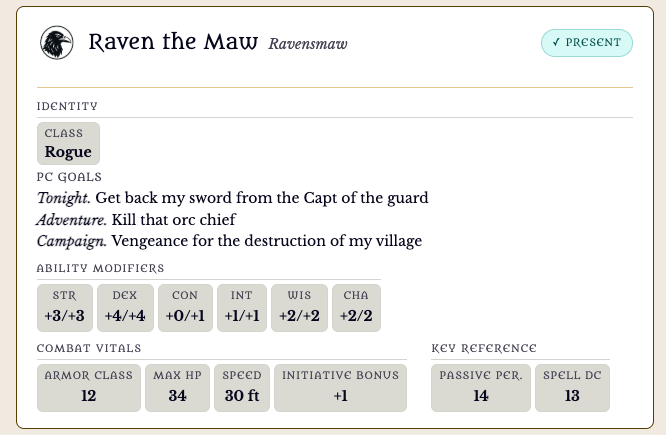
- Go into the character's stats manager and add a Tonight field. I named mine "Tonight" for obvious reasons. You can call it whatever. I also have a field for adventure goals and for campaign goals so I always keep them forefront. Your players goals - the heroes of the story - will end up driving most of teh action. The villain's goals are set - they will do dastardly deeds unless the heroes stop them.
- Ask your players to update it before each session—their goals for tonight, for the adventure, or for the whole campaign, whatever line they want to fill in. This is super helpful and it's a good routine to switch from everyone arriving and getting setup and BSing about the week to --- It's time to start.
Update your goals and stats, please.
You don't have to interrogate anyone for this. Just glance at the PC cards from last session, or let the players tell you themselves. Either way, this one step gives you invaluable insight into player intent and keeps you from spending an hour planning a scene nobody at the table actually cares about. PC Index cards are on the Game Session Binder on the PC Tab.
Step 2: Create a Strong Start
A strong start isn't a mystery—it's simply planning your opening scene.
This is the only point in the game where a Gamemaster has nearly complete control.
Return of the Lazy Dungeon Master, pg. 14
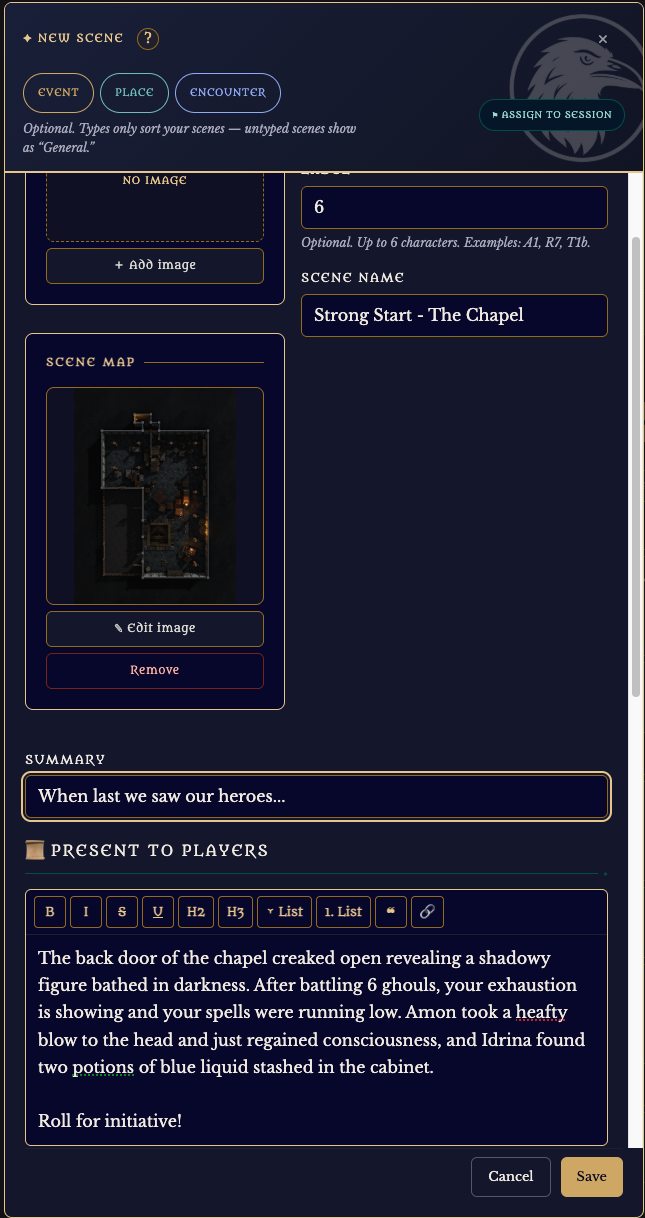
Your opening should:
- Recap what happened last session
- Introduce an immediate hook (a die roll, a line of dialogue, initiative for combat—whatever fits your system)
- Set the tone for the night ahead
A strong start can be as simple as "The tavern keeper approaches the party with an urgent whisper" or as detailed as you'd like. The key is that it's ready to go when the session starts.
The Adventure Planner is the best place to begin planning your next game. Click Create Scene, and you are off. A line of dialog, a roll for initiative, a decision.
Step 3: Outline 4-6 Potential Scenes
As Michael Shea writes:
With our strong start written out, we might next write down the potential scenes that take place during the adventure. Sometimes we have one obvious path to take. Other times, there might be multiple options for the characters to follow. Either way, a short list of potential scenes can help us feel as though we have a handle on the adventure.
Return of the Lazy Dungeon Master, pg. 18
You don't need to plan the entire adventure—just the scenes that might happen this session.
Usually, it's enough to come up with only a few words per scene, and to expect one or two scenes per hour of play.
Return of the Lazy Dungeon Master, pg. 10
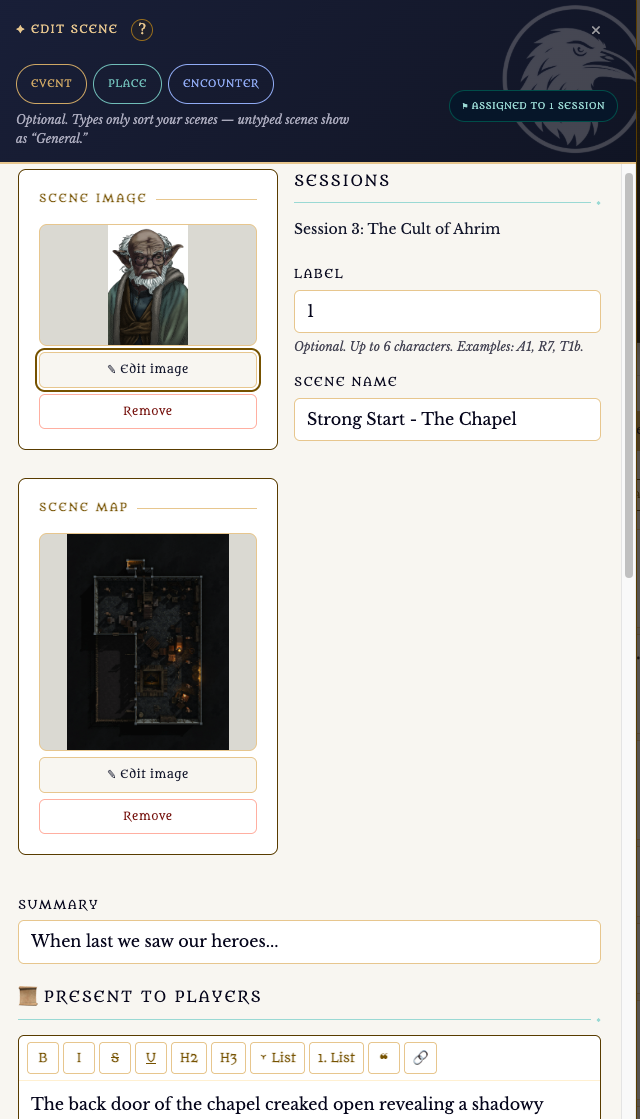
When you first start an adventure, you can decide to create your session or go straight to the meat of the work - planning your scenes. I recommend calling your first scene, Strong Start. Step 2 in the Sly Flourish process. I mean you can call it whatever, but starting each session with a strong start scene is a great idea.
Here's what's important: At one or two scenes per hour, most sessions land around 4-6 scenes across 3-5 hours of play—and honestly, you and I both know it could be as few as one or as many as eight. Plan the number that gets you feeling ready, not a number off a chart. This might include:
- A combat encounter with bandits (simple or complex—your choice)
- A social interaction with a key NPC
- Exploration or investigation
- A dramatic reveal or complication
You can plan each as a quick outline or fully detailed scenario. The flexibility is yours.
Step 4: Detail Your Scenes (or Don't)
This is where Quoth's flexibility shines. You can:
Light Planning:
- Write one-line scene descriptions
- Trust your improvisation for the details
Detailed Planning:
- Use the Scene Builder to plan combat mechanics
- Create full social encounter trees
- Develop complex NPC motivations
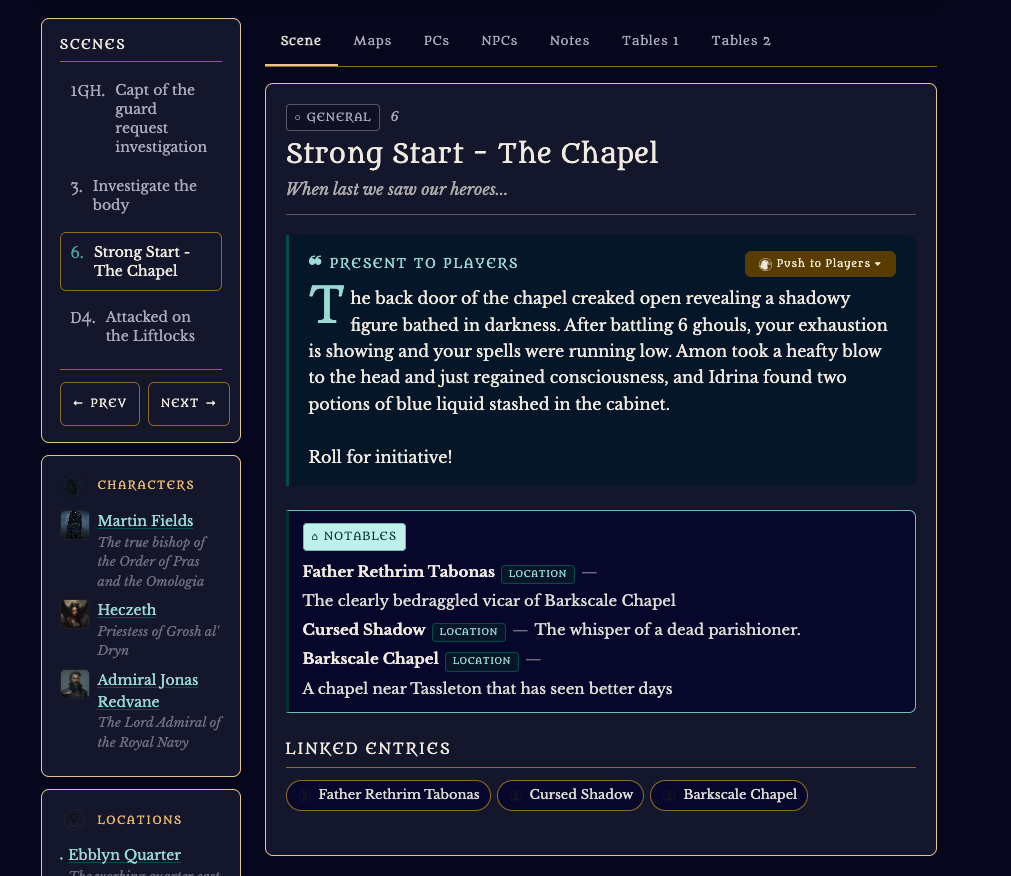
Here's the thing about "detail" in Quoth—it can be as small or as big as the scene demands. A run-in with a band of bandits can be a simple two-round scrap, or it can turn into a full social encounter with law, history, and machinations, where the bandit chief turns out to have a legitimate grievance and quietly becomes one of your campaign's main villains three sessions later. You won't know which one it is until you sit down to plan it, and that's fine.
The same flexibility works at dungeon scale. Planning a 10-room dungeon? Plan it as 10 scenes—one room, one scene, done. As you go, push each room straight into your World Codex so it's saved as a location forever. Then when your players wander into room 17 instead of room 3, you just drag it into the session and go.
As you plan, if you think of related NPCs or locations, simply click a button to create a stub—a quick placeholder Codex entry that you can flesh out later, scene by scene, stub by stub.
Step 5: Leverage the Spiral Outward Approach
You don't have to build the entire world before your first session. Instead:
- Start small: Introduce the immediate location (the tavern, the town, the dungeon entrance)
- Expand as they explore: As players discover new areas and meet new people, build only what they encounter
- Plan dynamically: If players express interest in finding a Thieves' Guild, create one NPC contact in that guild. As they investigate further, build that faction out—give it an organizational structure, a grand design to take over the criminal network of the entire country, whatever the scene calls for. If they get distracted chasing a dragon instead and the guild goes by the wayside, you'll never have to worry about its complex org chart, and you've saved yourself weeks of unnecessary planning.
As the characters explore the world, your focus on that world spirals outward. Only when they reach the nearby city do you take the time to fill out that city. Return of the Lazy Dungeon Master, pg. 47
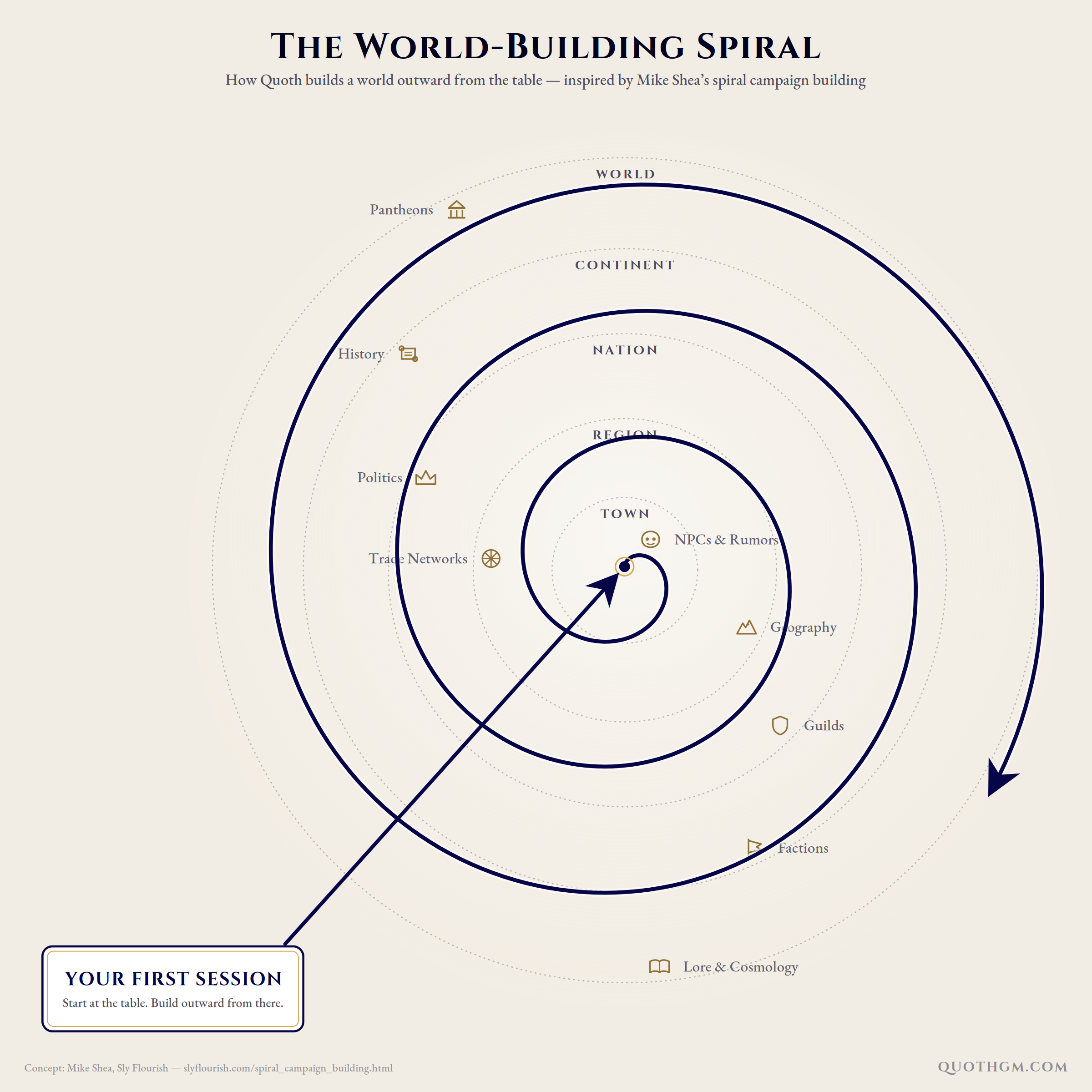
This is Mike Shea's most powerful insight: build what you need when you need it. Your life doesn't begin in a history book, and neither does your first-level party's. It begins in a small town, at a tavern, with a job. Describe that small place well, and let the spiral do the rest.
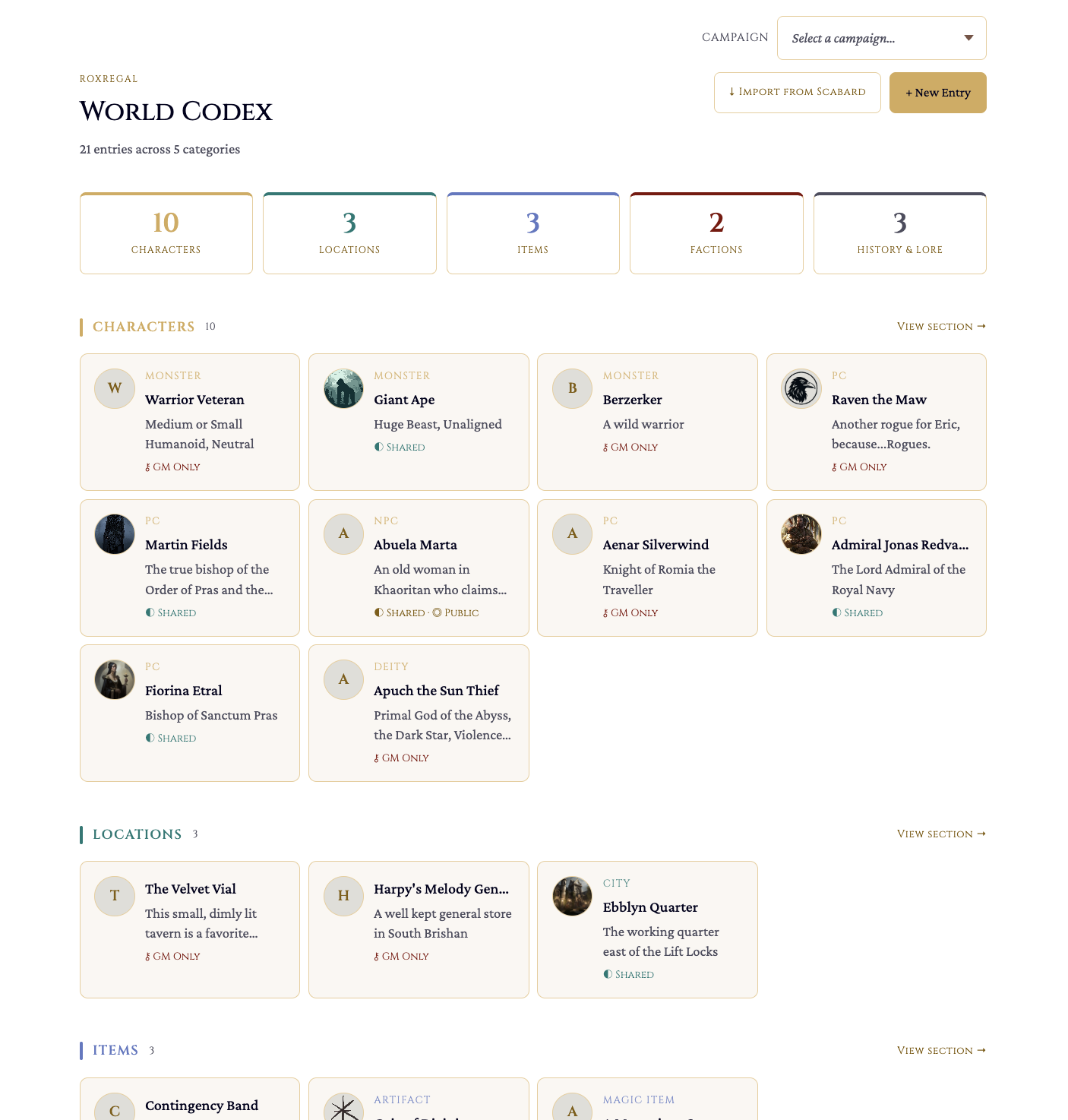
Step 6: Add Scenes to Your Session
Once you've outlined your scenes, bring them into your session plan.
Now you have your complete session blueprint, organized and ready to reference mid-game.
Step 7: Run Your Session with the Game Session Binder
The Game Session Binder is your command center during play.
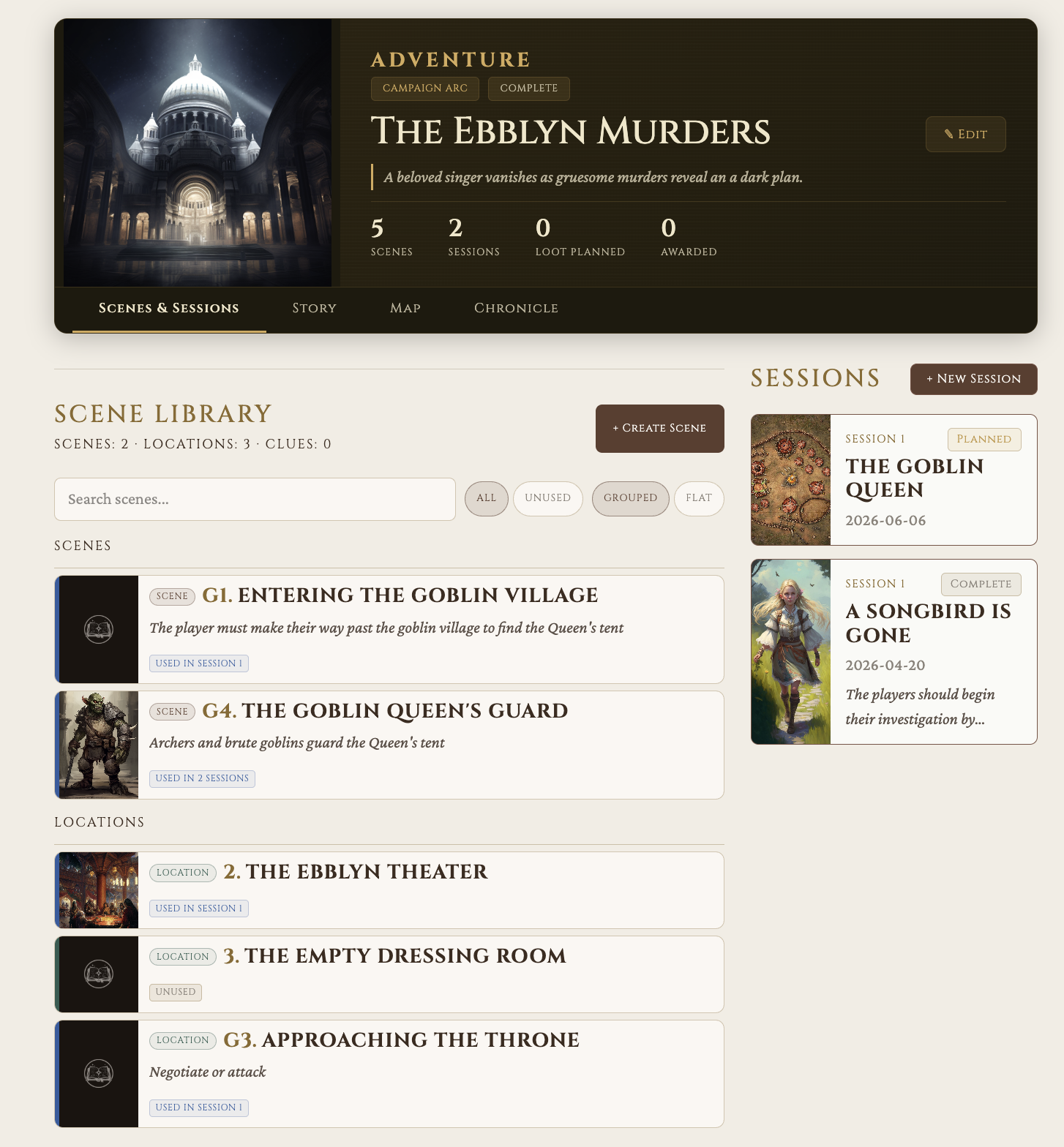
Click through scenes in any order—if your players unexpectedly decide to raid Room 17 first, you're ready. Each scene is a quick click away.
Add scenes on the fly: Say it's Wednesday night, you're prepping for Thursday's game, and you realize you skipped a scene you actually want. Simple—open the Scene Planner in the Game Session Binder, see everything you've already added, and create the new one. Or maybe it happens mid-session: the players wander off somewhere you never expected. Pop open the Scene Planner right there at the table and start riffing. You've got a stub for it, it's permanently saved, and you'll thank yourself when they inevitably go back.
Step 8: Reuse and Repurpose Unused Scenes
Scenes you don't use aren't wasted—they're saved in your Scene Library.
Now, here's where Quoth and Mike Shea politely part ways. His advice for a scene you don't end up using:
Don't fall in love with your scenes. Be prepared to throw them away. Return of the Lazy Dungeon Master, pg. 19
Great advice for keeping your prep light. Terrible advice if you just spent twenty minutes on the coolest fight against the strangest creature on the planet and your players simply never wandered that direction. Quoth doesn't make you choose—it just quietly saves it for you.
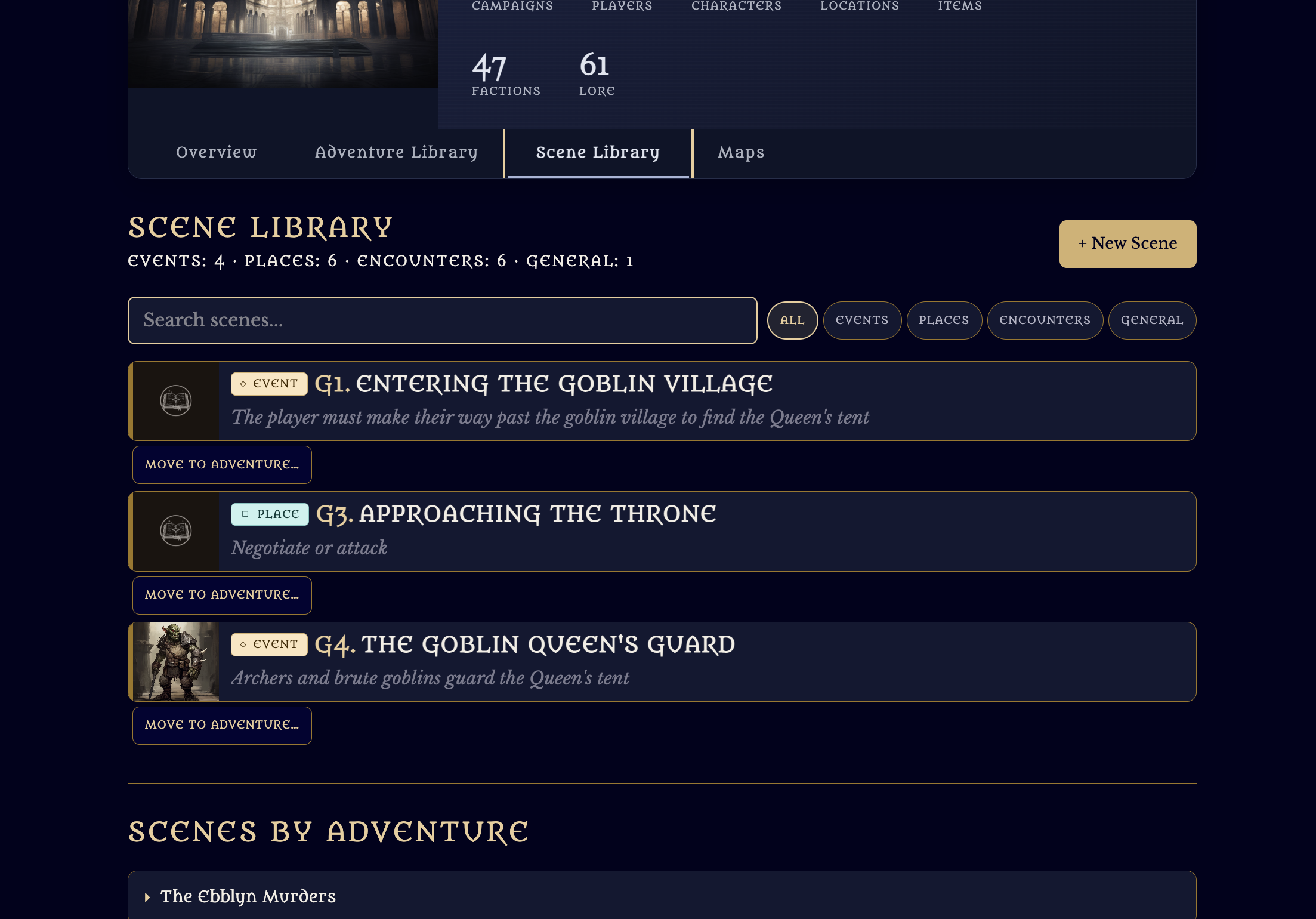
Here's the workflow:
- Create a detailed scene about a dragon that your players never encounter
- Save it (it's automatic)
- When planning your next adventure, visit your Scene Library on the World page
- Move that dragon scene to your new adventure
- Throw the players into that dire situation whenever you're ready
No deleted work. No lost inspiration. Just a growing collection of reusable encounters ready for when you need them.
Why This Works
The genius of this system—both in Shea's original 8-step method and in Quoth's implementation—is that it respects how game masters actually think. You're not starting with a 10,000-year history or a detailed pantheon. You're starting with:
- What your players want
- How you'll hook them tonight
- What might happen next
- Only the details you need right now
That's the whole idea behind Quoth: make your life easy as a Game Master, and let the process flow from how GMs actually think—not about building out a monstrous new cosmology, but about planning the next game and spiraling outward from there. Build your world one experience, one combat, one social encounter, one scene at a time.
That's efficient preparation. That's the Lazy Dungeon Master way. And that's exactly what Quoth was built to support.