Ok. I am just about done with how worldbuilding apps work or fail to work.
A location is not a scene.
A scene is not a wiki entry.
A Session Plan is not history of the world. A digital session binder must be a a context-sensitive orchestration surface that compensates for limited screen space through state, prediction and action. And a session log is not a session plan.
There are pieces of data about the fantasy world that live in the imagination of TTRPG players. Then there is the real world. The place where we use a calendar to plan a game, a table where we roll a die, and where we spill pizza sauce on our character sheets. Then there are sessions - a liminal space between worlds - the nexus of all realities where die rolls kill gods and players forget they have a healing potion because it's covered by pizza sauce, so Timmy the Thief dies.
- There are scenes - a plan for what might happen in a place, what might be said by an NPC, what happens if a puzzle is not solved, fights that might not happen - a realm of possibilities.
- There are adventures filled with scenes that may never occur.
- Campaigns filled with plans and machinations that will happen if the heroes decide to raise carrots instead of become adventurers.
But, sometimes it feels like most of the GM helpers out there struggle to distinguish between those things. If the goals is to make something of use to a GM during a game that transcends just another wall of text, then Scenes, Adventures, Campaigns, and Game Sessions have to have function beyond simply content. An Adventure is a plan. A plan for a myriad of scenes, a general goal, an objective.
A session plan arranges possibilities. A session realizes some of them. A chronicle records the resulting facts. A tool developer who designs for the TTRPG table must functionally decide what their tool is. Is the tool just a record of information, or will the tool support play. Moreover, will the tool primarily focus on the needs of the GM, or will it serve the vast majority of TTRPG players who will never be GMs?
Kirsh and Maglio distinguish pragmatic actions, which directly change the external situation, from epistemic actions, which rearrange the environment to make thinking easier, faster or less error-prone. “On Distinguishing Epistemic from Pragmatic Action”
GM activities are full of epistemic actions:
Laying three NPC cards beside the current map Moving defeated creatures out of view Placing an unused scene in tonight’s session Marking a clue as revealed Reordering possible scenes after an unexpected decision Pinning the antagonist’s objective beside the initiative tracker Separating public information from secret information
"TRPG narratives are collaborative. Indeed, the first academic treatise on the subject was Gary Alan Fine’s Shared Fantasies. While the game book is created by game designers, published, and sold to the players, its setting will only come alive when players narrate their own stories within....Indeed, the TRPG player tends to be much more powerful than the consumer of genre narratives, since, to play a game, they have to produce a narrative for themselves." (Nikolaidou, 2018).
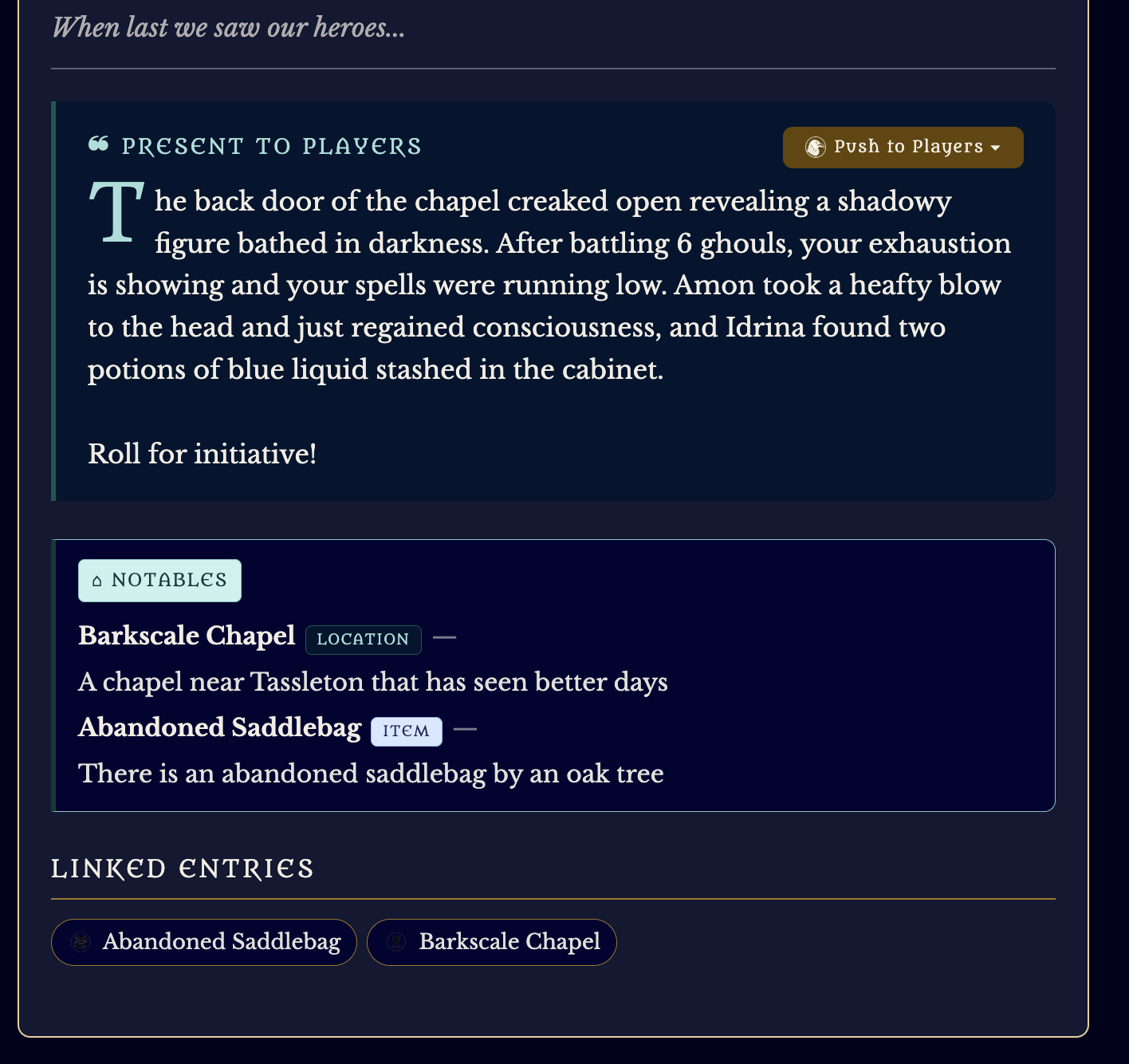
The QuothGM Session Binder cannot fully approximate the GM Screen. A GM screen provides at least four functions:
The GM screen provides:
- External memory: rules and tables do not have to be remembered.
- Stable spatial indexing: the GM learns approximately where information lives.
- Peripheral availability: several categories remain simultaneously visible.
- Information control: physical opacity divides public and private knowledge.